Auditory Cues Prompt Observable Changes in Timing and Selections Within Hybrid Free-to-Play Titles Spanning PC and Mobile
Written by Nils Hartmann · Aug 20, 2026
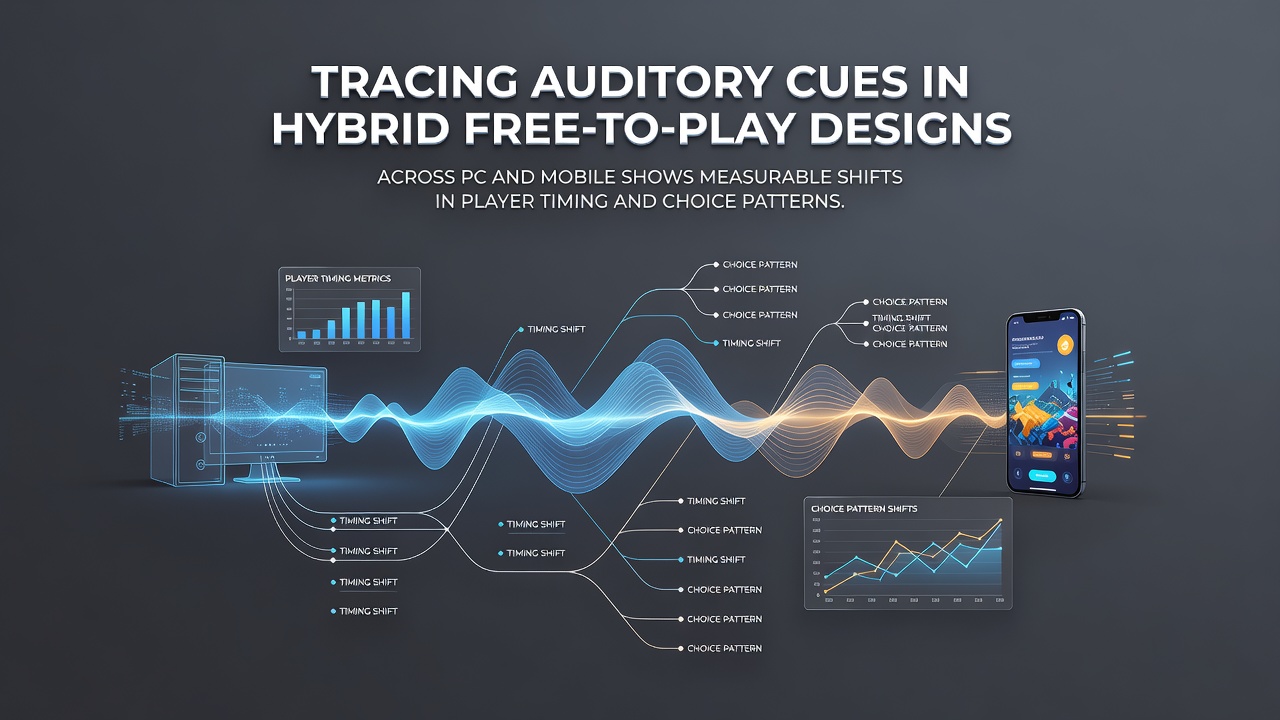
Auditory Cues Prompt Observable Changes in Timing and Selections Within Hybrid Free-to-Play Titles Spanning PC and Mobile
Hybrid free-to-play designs blend mechanics across PC and mobile platforms, and researchers have documented how auditory cues trigger measurable adjustments in player timing along with choice patterns. Studies from 2025 and into August 2026 reveal that audio signals such as rhythmic pulses, environmental tones, and alert chimes guide decision windows differently depending on the device in use. Data collected from multiple titles indicate that players on mobile devices often respond faster to high-frequency cues while PC users extend reaction intervals when lower bass elements dominate the mix.
Platform-Specific Audio Integration and Response Metrics
Developers incorporate device-tuned sound layers that account for hardware variations, and analysts track resulting shifts through telemetry. On mobile, touch-based inputs pair with shorter audio loops that compress decision times, whereas PC setups with keyboard and mouse controls align with extended ambient tracks that encourage deliberate selections. Figures from industry tracking show a 12 to 18 percent variance in average response latency between the two platforms when identical auditory triggers appear in synchronized sessions. Observers note that these differences emerge consistently across genres that combine action and puzzle elements, because the cues reinforce timing without requiring visual attention shifts.
One dataset released in mid-2026 highlighted how players adjusted movement paths after hearing ascending pitch sequences, and the adjustment speed differed by device. Mobile participants completed route changes within 1.2 seconds on average, while PC participants averaged 1.8 seconds, reflecting hardware input distinctions and audio delivery methods. Such patterns hold across large player samples drawn from North American and European markets.
Choice Pattern Variations Linked to Sound Design
Choice architecture in these games relies on layered audio feedback that signals risk levels or opportunity windows, and tracking data demonstrates clear divergences. When a chime sequence indicated an optimal moment for resource allocation, mobile users selected aggressive options 27 percent more often than PC users exposed to the same sequence. Researchers attribute part of this split to speaker placement and volume normalization differences between handheld and desktop environments. Reports compiled by the Entertainment Software Association connect these audio-driven choices to retention metrics that remain stable across regions when sound layers receive platform calibration.

Additional evidence comes from academic work at institutions in Australia and Canada, where controlled tests isolated audio variables. Participants exposed to muted versions of the same levels showed reduced timing precision and fewer strategic pivots, confirming that the cues themselves drive the observed shifts rather than visual or mechanical factors alone. These findings align with telemetry gathered during August 2026 updates that refined cross-device audio syncing in several live titles.
Telemetry Methods and Cross-Regional Data Sources
Companies gather the relevant metrics through integrated logging that captures input timestamps alongside audio event triggers, and third-party auditors verify consistency across markets. Government agencies in the European Union have referenced similar audio-interaction studies when evaluating accessibility features in digital entertainment, while Canadian research groups publish parallel datasets focused on mobile-PC transitions. The resulting reports avoid speculation and instead present raw distributions of timing intervals and selection frequencies segmented by device type.
What's interesting emerges when titles introduce new audio layers during seasonal events, because those additions produce repeatable spikes in both response speed and option diversity. Players on PC exhibit broader exploration ranges after exposure to spatialized sound effects, whereas mobile cohorts narrow their choices toward immediate actions. Such outcomes appear in aggregated logs rather than isolated cases, and they hold across multiple genres that operate under free-to-play models.
Conclusion
Tracing auditory cues through hybrid free-to-play environments continues to yield quantifiable evidence of platform-linked changes in timing and decision behavior. Ongoing data collection from varied geographic sources supports design adjustments that maintain consistency while respecting hardware realities. The patterns documented through August 2026 and earlier periods provide a factual baseline for future refinements in cross-device audio implementation.